- +234 70 4149 7660
- info@ekundayoeduconsult.com
- Lagos Nigeria

Basic and Advanced Electrocardiography Level 2
Electrocardiography (ECG Course, Level 2)
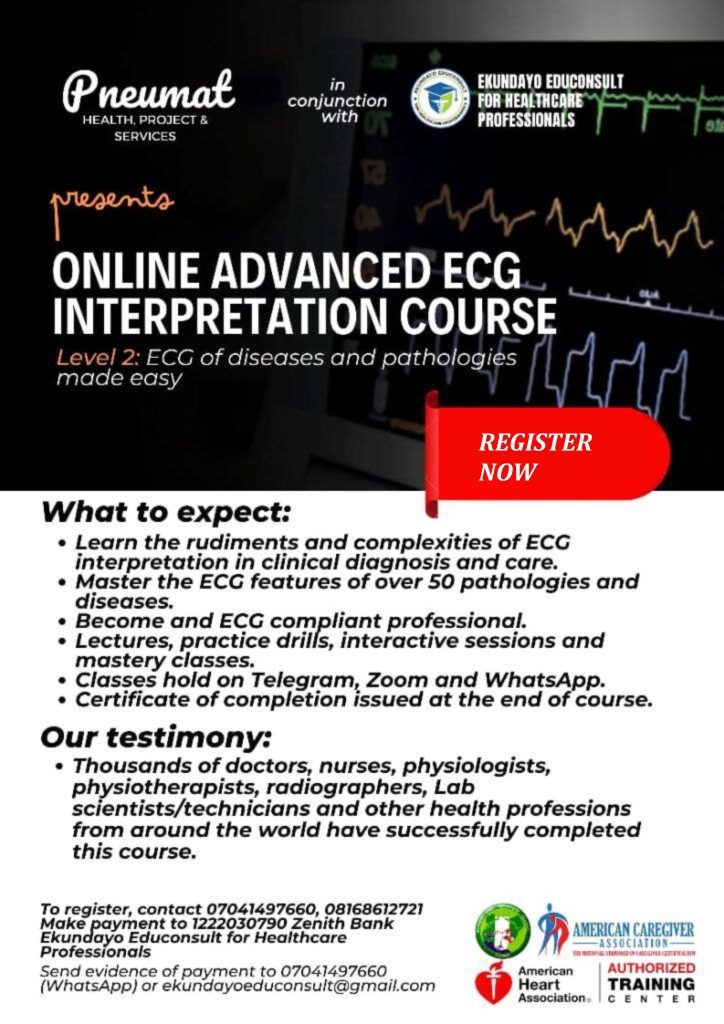
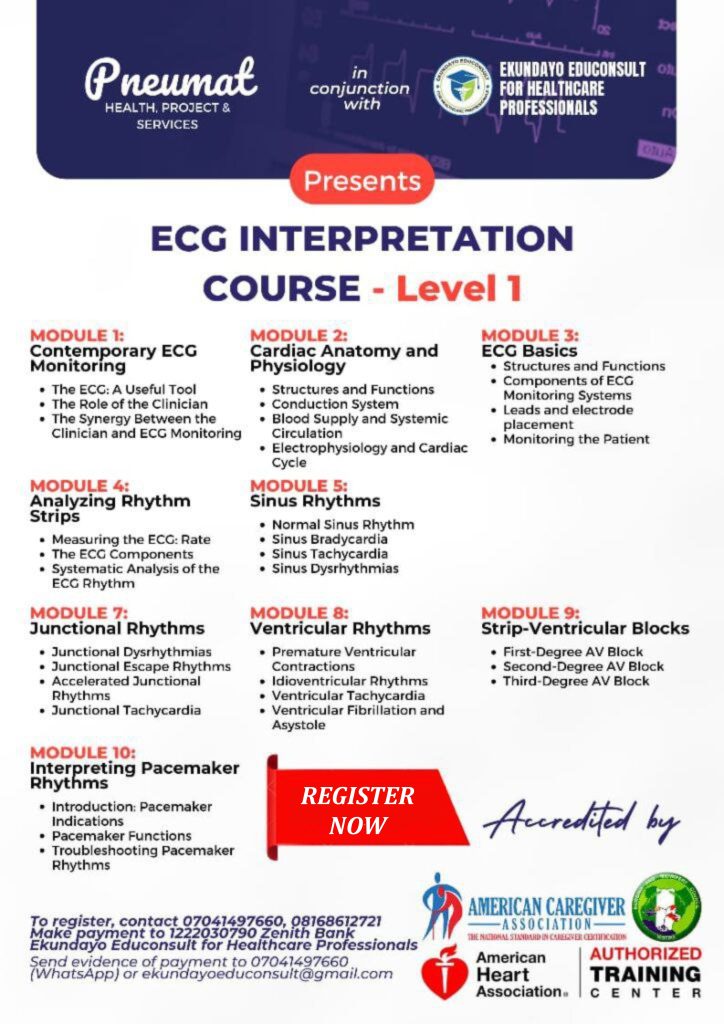
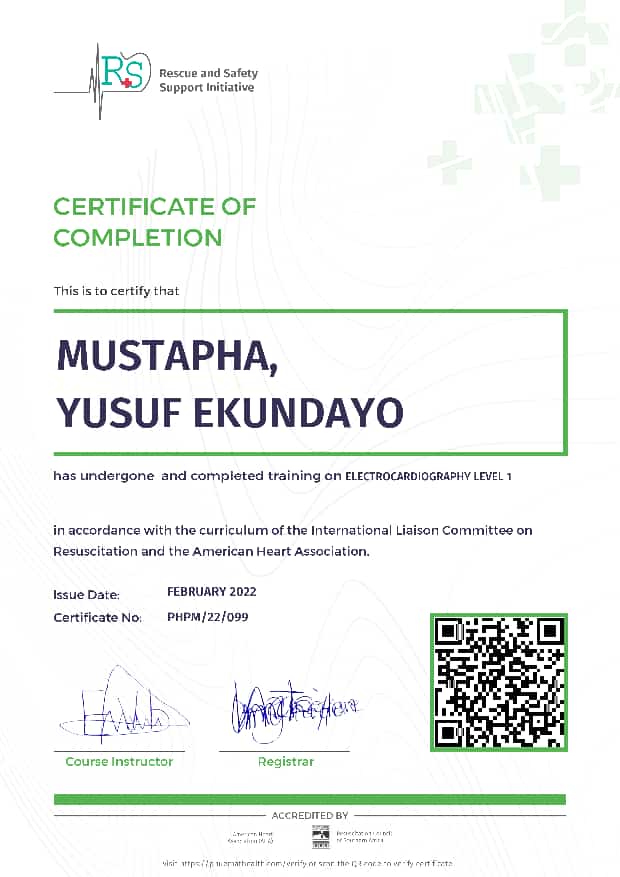
Verifiable certificate sample For Electrocardiography
THE TRUTH YOU NEED TO KNOW ABOUT ELECTROCARDIOGRAPHY INTERPRETATION LEVEL 2 ( ECG OF PATHOLOGY AND DISEASES)
(Video explaining the breakdown of our training methods)
PAYMENT AND REGISTRATION DETAILS
Company’s Account
1222030790
Zenith Bank
Ekundayo Educonsult for Healthcare Professionals.
Domiciliary Account
3184967233
First Bank of Nigeria
Mustapha Yusuf Ekundayo
For International Students
Any of the options below can also be used
– Western Union
– Money gram
– World Remit
– Mukuru, etc
Send proof of payment through our WhatsApp Chat Icon visible on every page
Basic and Advanced Electrocardiography Level 2
Basic and Advanced Electrocardiography Level 2: Elevate Your Diagnostic Skills
Introduction
Electrocardiography Level 2 builds upon the foundational skills acquired in Level 1, introducing advanced concepts and techniques for interpreting complex cardiac rhythms and conditions. This level is designed for healthcare professionals seeking to enhance their diagnostic capabilities and manage intricate cardiac cases effectively.
In this guide, we delve into the critical aspects of Level 2 electrocardiography, including specialized diagnostics, interpretation of challenging patterns, and clinical applications.
1. Why Advance to Level 2 Electrocardiography?
1.1 Beyond the Basics
While Level 1 covers fundamental concepts, Level 2 focuses on interpreting subtle and complex changes in ECG readings that require advanced knowledge.
1.2 Enhancing Diagnostic Accuracy
Level 2 training equips professionals to diagnose rare and life-threatening conditions such as Brugada syndrome, long QT syndrome, and ischemia with non-traditional presentations.
1.3 Target Audience
- Cardiologists and advanced trainees.
- Emergency and critical care professionals.
- Physicians specializing in electrophysiology.
- Advanced practice nurses and physician assistants.
2. Advanced ECG Components in Level 2 Training
2.1 In-Depth Analysis of Complex Patterns
- Brugada Syndrome: Recognizing coved ST-segment elevations.
- Wolff-Parkinson-White (WPW) Syndrome: Identifying delta waves and associated tachyarrhythmias.
- Long QT Syndrome: Measuring corrected QT intervals (QTc) and identifying triggers for torsades de pointes.
2.2 Advanced Arrhythmia Diagnostics
- Differentiating between atrial flutter and atrial fibrillation with aberrancy.
- Recognizing polymorphic ventricular tachycardia.
- Evaluating junctional rhythms and multifocal atrial tachycardia (MAT).
2.3 Advanced Ischemic Changes
- Subtle ST-segment depression in reciprocal leads.
- Identifying high-risk T-wave inversions.
- Recognizing atypical presentations of myocardial ischemia.
3. Specialized Techniques and Tools
3.1 Advanced Signal Processing
- High-resolution ECG for detecting late potentials.
- Signal-averaged ECG for arrhythmia risk assessment.
3.2 Holter Monitoring and Ambulatory ECG
- Analyzing 24-hour recordings to detect transient arrhythmias.
- Identifying patterns of ischemia during daily activities.
3.3 Stress Testing with ECG
- Understanding exercise-induced arrhythmias.
- Evaluating ischemic changes during stress.
4. Applications of Level 2 Electrocardiography in Clinical Practice
4.1 Emergency Medicine and Critical Care
- Diagnosing cardiac arrest causes such as hyperkalemia or drug toxicity.
- Rapid identification of lethal arrhythmias like ventricular fibrillation.
4.2 Cardiology Clinics
- Monitoring patients with pacemakers or ICDs.
- Managing complex arrhythmias in outpatient settings.
4.3 Electrophysiology
- Pre- and post-ablation assessments.
- Mapping conduction pathways in arrhythmias.
4.4 Research and Innovation
- Utilizing advanced ECG data in clinical trials.
- Exploring the role of artificial intelligence in ECG interpretation.
5. Training and Certification in Level 2 Electrocardiography
5.1 Curriculum Overview
- Module 1: Advanced cardiac electrophysiology.
- Module 2: Complex arrhythmias and conduction disorders.
- Module 3: Case-based learning and problem-solving.
5.2 Certification Benefits
- Validates expertise in advanced electrocardiography.
- Recognized by professional bodies such as the European Society of Cardiology (ESC).
5.3 Practical Sessions
- Hands-on experience with high-end ECG machines and software.
- Interpretation of challenging case studies.
6. Tips for Excelling in Advanced ECG Interpretation
6.1 Develop a Methodical Approach
- Start with basic rhythm analysis before focusing on complex patterns.
6.2 Stay Updated
- Regularly review guidelines from institutions like the American Heart Association (AHA).
6.3 Engage in Collaborative Learning
- Discuss complex cases with peers or mentors to gain new insights.
6.4 Leverage Technology
- Use advanced software for digital ECG analysis.
7. Why Choose Ekundayo Educonsult for Level 2 ECG Training?
7.1 Expert Instructors
- Led by seasoned cardiologists and electrophysiologists.
7.2 State-of-the-Art Facilities
- Access to advanced diagnostic tools and simulators.
7.3 Flexible Training Options
- Blended learning combining online modules with onsite workshops.
7.4 Comprehensive Support
- Guidance throughout the certification process.
7.5 Global Recognition
- Certification recognized by international healthcare institutions.
8. Advancements in Electrocardiography Technology
8.1 Artificial Intelligence in ECG
- Automating ECG interpretation for enhanced accuracy.
8.2 Wearable ECG Devices
- Continuous monitoring for at-risk patients.
8.3 Integration with Electronic Health Records (EHR)
- Streamlined workflow and data analysis.
Conclusion
Level 2 electrocardiography training bridges the gap between foundational skills and specialized expertise, enabling healthcare professionals to handle complex cardiac diagnostics confidently.
At Ekundayo Educonsult, we offer an unparalleled training experience, equipping you with the knowledge and skills to excel in advanced ECG interpretation. Enroll now and elevate your career in cardiovascular healthcare!